









Historisches Museum der Pfalz Speyer Historisches Museum der Pfalz Speyer
  Change contrast English Choose language
normal font size large font size huge font size Change contrast

Römerzeit (Roman Era)

Salvete – Greetings!

Soldier

Keeping a constant eye on the visitors, the three Roman soldiers are on guard. In the Palatinate, one of the outermost border regions of the Roman empire, caution is paramount. The wild Germans could cross the border at any time and cause a disturbance. However, at the moment, everything is peaceful. The soldiers even invite everyone to take a look at their camp. The “Contubernium“, built with great respect for detail from authentic materials in the half-timbered method of construction, was transfered here from the Youth Museum. It shows a bed for the night in a Roman military camp of the Late Romantic period.

Military Life

The kitchen

The first Romans, who came to the Palatinate from the South, were soldiers. In 12 AD, Roman troops occupied the land, built streets, set up camps and carried out the Roman administration in their new province of Upper Germania. They brought their weapons and armor along from Rome. The three simulated soldiers wear the armament that was typical of the time between the 1st and 4th centuries; it has been reproduced here in the every detail.


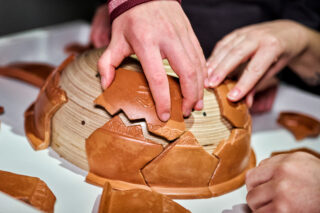
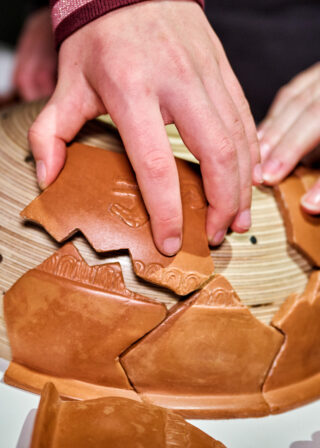
During peacetime, the soldiers worked at various crafts. Tradesmen and craftsmen came along to the Palatinate with the military, built their workshops here, and marketed their wares here. In Rheinzabern, there was a ceramics center that produced roof tiles as well as the highly regarded tableware called “Terra Sigillata”. That fine tableware traveled along lengthy trade routes as far as Britain and the Black Sea.

Privat Life

A walk through the Roman Period exhibition shows not just the military aspects and craftsmanship of this period but also provides insight into the private lives of the inhabitants of what amounted to Rome’s “boondocks” (i.e. that part of the empire farthest from Rome). The realistic staging of the soldier’s living quarters seen here—a living room and a kitchen—creates the impression that the occupants had left these quarters just a few minutes before.

A Palatine Roman

Born near Speyer, the young Nemeter Atrectus is understandably drawn to the military. Around 80 AD, he enters service in the Roman cavalry. At first, he secures with his comrades the borders of the Roman empire in today’s Hungary, before his unit is transfered to today’s Bulgaria. For 25 years, he serves there as a loyal soldier. On May 13, 105 AD, he honorably takes leave of the army. In recognition of his service, he receives a stipend of money and a certificate that confers on him Roman citizenship. Atrectus, who now calls himself Marcus Ulpius Atrectus, wants to enjoy his well-earned retirement. Yet, the Dacians thwart his plans. Atrectus is once again enlisted to defend his land. He never returns to the Rhine.


Master Craftsman

Centaur´s Head

The centaur’s head is an outstanding masterpiece of bronze casting. The head, which was found near Schwarzenacker, dates from the time of Emperor Augustus and was later revamped and furnished with a hook. That way, it could serve as a weight for a portable scale. Although the head is not very large, the artist succeeded in capturing all of the concentrated power of the mythical centaur in its facial features, flowing beard and glistening eyes.

Picture Gallery

Römerzeit
(Number of pictures: 29)

Kentaur.jpg

Virtual Tour

Ausstellung Römerzeit
Start our
Virtual Tour

Bookmark

Mr.Wong Webnews Folkd Yigg Digg
del.icio.us Reddit Yahoo Google